When ground conditions start asking hard questions, come prepared with answers.
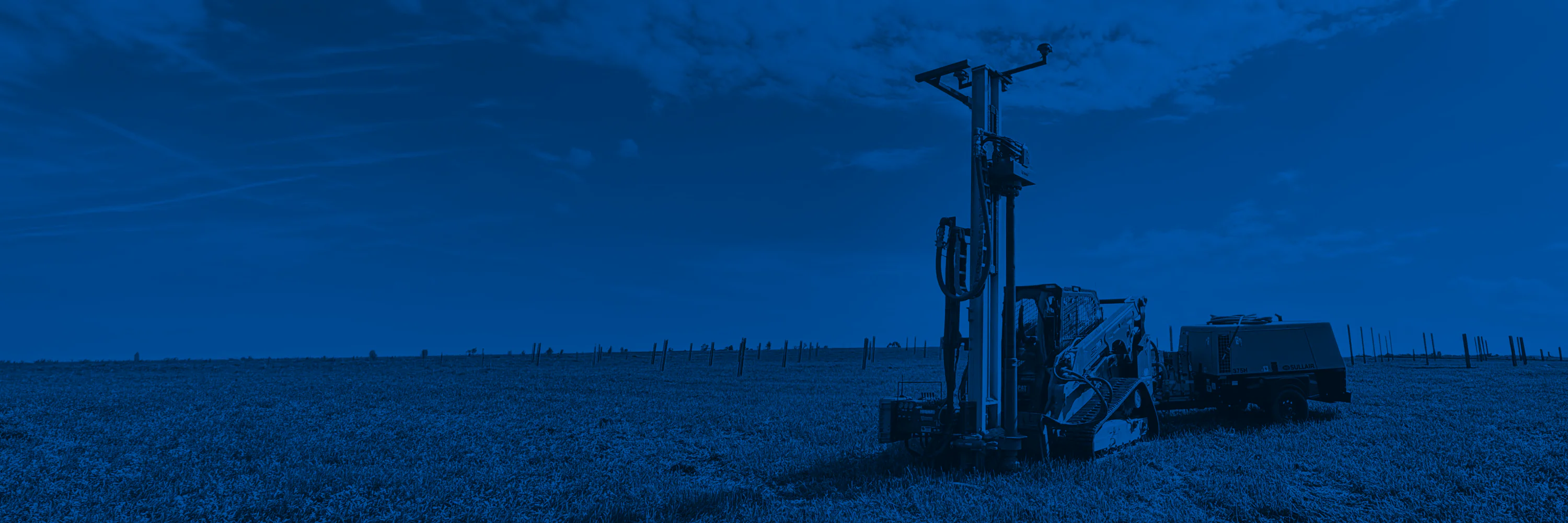
Utility solar projects require repeated foundation drilling or pile driving, but the ground beneath those locations is rarely consistent, with contractors encountering clay, cobble, weathered formations, or hard rock. The answer to these refusal zones is pre-drilling, which penetrates tough ground conditions to allow for the installation of driven piles or ground screws. Of course, the right drill mast is needed to meet the specified hole requirements, while offering practicality and versatility for the job at hand.
Start with the site
Three conditions shape the equipment decision: geology, topography, and site space.
Ground conditions and geology will determine the drilling method, tooling, and torque required. It’s not always the case that the most powerful drill mast and largest DTH hammer are required – right-sizing is important.
Topography affects carrier stability and the ability to position a long mast. A purpose-built drill rig may not be suited to working on uneven ground, while softer soil may not bear the weight of heftier carrier equipment.
Finally, working space can limit mast height, the physical dimensions of the equipment you use, or the amount of plant machinery on site – particularly around existing structures or on projects with restricted access.
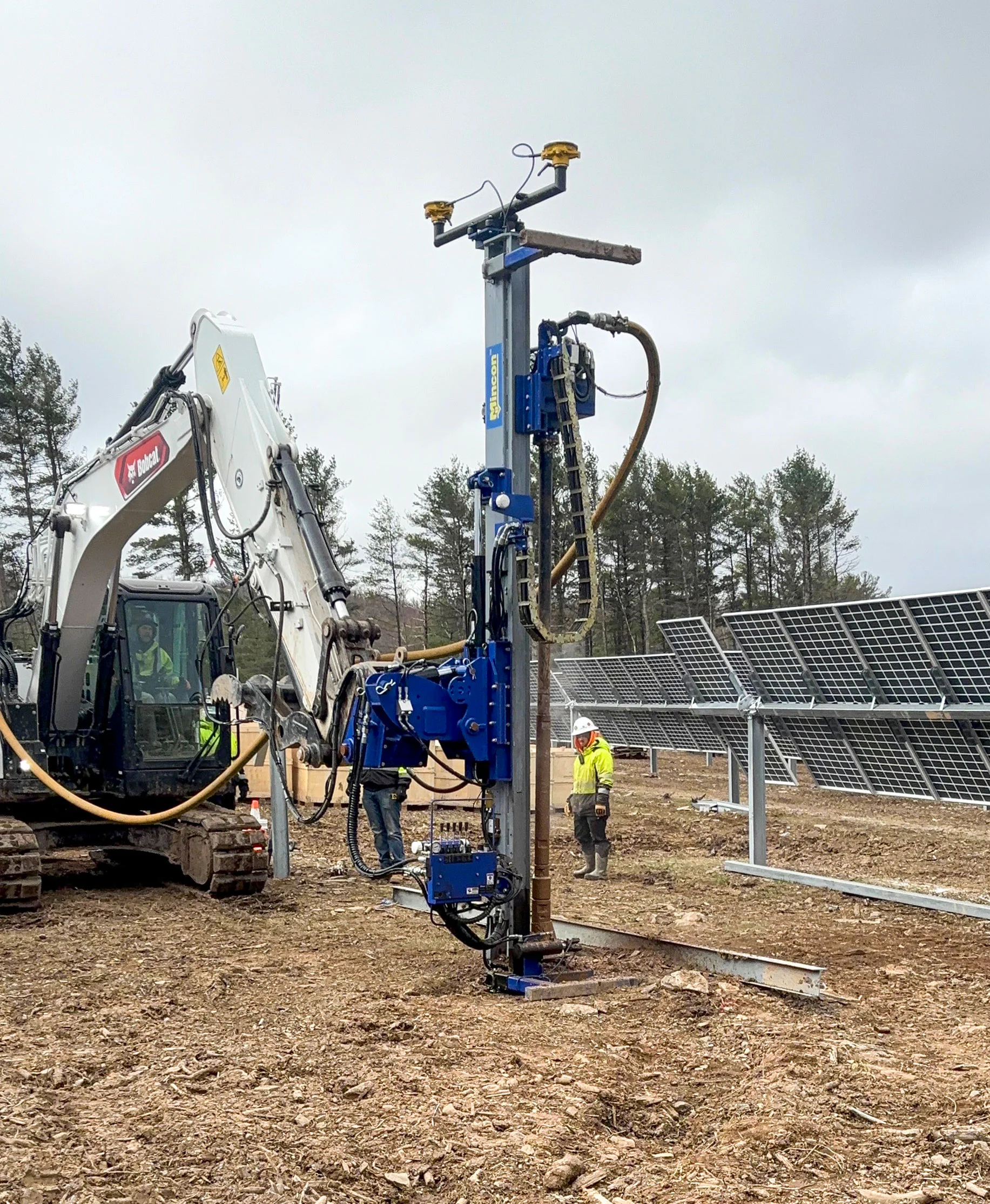
These conditions should be understood before a drilling approach is chosen – and could be the factors that point to the use of a mast integration. If your project already has skid steers and excavators, mast integrations – both for drilling and pile driving – help streamline site logistics and increase utilization of machinery already on site.

Single pass or added drill steel
Depending on how deep you’re going, you may either rely on single-pass drilling or a multi-step process.
Single-pass drilling means reaching the required depth without stopping to add drill steel – your drill string is exactly long enough to drill, retract, and move on to the next hole in a single coordinated process. The benefits are increased productivity, greater efficiency, and less operator interaction. On projects with hundreds or thousands of foundation piles, those benefits add up to savings in time, fuel, and total costs.
For this reason, mast lengths are a critical decision – and longer is not always better. A hole deeper than 20 feet will require drilling to stop for additional drill pipe to be added. Transportation limits, indoor height restrictions, uneven terrain, or limited working space may also favor a shorter mast.
As a practical guideline, adding more than three sections of drill pipe should be avoided unless the job contains only a small number of holes. In production drilling you want to keep the process simple and the drill string as short as necessary.
Match the mast to the requirement
Project engineering establishes the foundation type, hole diameter, depth, pile reveal, and other installation requirements. A typical solar pre-drilling application may call for a hole 5 to 12 inches in diameter and no deeper than 20 feet. Mincon drill mast integrations can accommodate applications up to 16 inches in diameter and approximately 60 feet deep, although those conditions are outliers and require a detailed application review.
The M1-series drill masts can be used to drill holes up to 8 inches in diameter, with rotary drill heads that have up to 5,000 ft-lb torque, while allowing use of a smaller suitable carrier. The M2-series masts allow for drilling holes up to 16 inches in diameter, with rotary drill heads that have up to 10,000 ft-lb of torque. M2-series drill masts will also require larger carrier equipment. All current mast selections require hydraulic flow above 30 GPM. Within each series, stroke length determines which model can complete the required depth in a single pass: the M1-series comprises the M106, M112, and M120 models, denoting 6-, 12, and 20-feet of stroke. Similarly the M2-series has M207, M212, and M220 models, with stroke of 7-, 12-, and 20-feet.
The selection process is simple: identify the type of work you need to do, establish the hole and torque requirements, select the needed stroke length, confirm that the carrier equipment is compatible, and that the site supports the chosen configuration.
The ground always has a say
A productive drilling package is not simply the mast with the greatest capacity: it is the package that meets the engineered requirement without creating avoidable problems in transportation, positioning or tooling recovery. When the application, carrier and site conditions are evaluated together, the mast becomes part of a complete foundation solution.
Learn more at mincon.com/category-services/mast-integrations/
Next in the series: Mincon innovations that help you drill smarter not harder